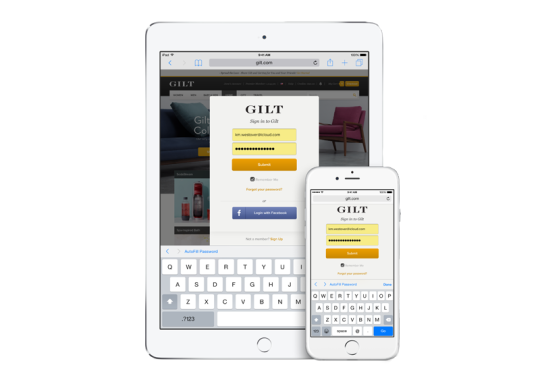
If you’re an iPhone or iPad user, odds are that you use mobile Safari to do all of your web browsing. But buried underneath all all of the more overt browsing options is a hidden way to search an individual webpage for a specific word or phrase.
Here’s how you can find it and use it to your heart’s content.
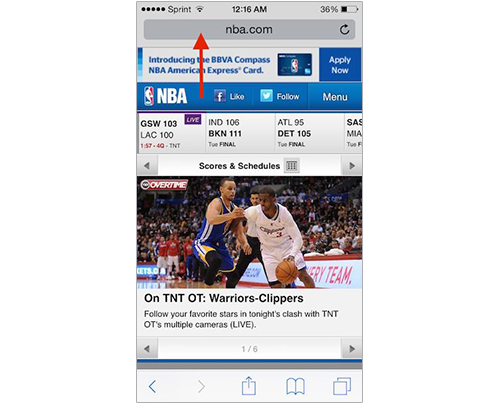
Let’s say I hop on over to NBA.com and want to quickly scan the page for any stories involving, say, Kevin Durant. Instead of tediously scrolling through the entire webpage and hoping to spot a story of interest, iOS provides a clever way to do all of the heavy lifting for you.
To get started, simply apply a single tap to the URL bar, highlighted below.
Once the URL bar becomes highlighted, you can begin typing in your search phrase which, in this case, is “Durant.”
Next, you’re presented with what appears to be a standard Safari search results page. Clearly these are of no help.
But here’s where things get cool.
Simply scroll further down on the page and you’re soon presented with a previously hidden category which lists out all of the instances in which “Durant” is found on the webpage in question.
Boom. There it is.
Following that, simply tap on “durant” and you’re whisked back to the NBA.com homepage and all of the instances of “Durant” on the open page will be highlighted in yellow. What’s more, iOS makes it easy to navigate between each instance of the word simply by tapping the arrow keys on the lower left hand side of the display.
For a feature that’s as useful and widely used as in-page search, one would think that Apple would advertise this functionality just a little bit more. Either way, this handy tip should help save some time you might otherwise spend searching and slogging through a massive webpage with tiny text.
The iPad Air 2 is Apple's latest flagship tablet, but the device hasn't done much to bolster slumping sales.Sarah Tew/CNET
When Steve Jobs showed off what he called the "truly magical and revolutionary" iPad in 2010, no one guessed just how quickly it would take off.
The 3-year-old iPhone may have been a surefire hit at the time, but the iPad was a wild card. Analysts' predictions for first-year sales ranged wildly between 1.1 million and 7 million units, according toAsymco.
Apple sold 14.8 million iPads in that first year.
It's hard to overstate the impact the iPad had on the consumer-electronics industry. Much like the iPhone reimagined the cell phone, the iPad redefined the tablet -- previously clunky, bulky laptoplike devices often built for specific work purposes -- and essentially created a new product category that heavy hitters such as Samsung and Microsoft are still chasing. The iPad, which was the last new product introduced by Jobs, quickly became a household name and further stretched Apple's dominance in the mobile arena.
"It took a tiny, tiny market and turned it into a mainstream product," said Jan Dawson, an analyst at Jackdaw Research. "That's what Apple does."
But the iPad, which first hit the market five years ago Friday, is at a crossroads. Shipments have slumped despite Apple's best efforts to entice consumers with thinner and smaller models. The question that originally dogged the first iPad -- why buy one? -- has arisen again withsmartphones getting largerandlaptops getting lighter and more compact.The numbers are staggering. Apple has sold more than 250 million iPads, making it the fastest-selling product in the company's history. There are more than 675,000 apps designed specifically to run on the tablet.
Apple CEO Tim Cook calls the weakness a "speed bump," and has said he believes the long-term opportunities remain strong. Apple is rumored to be working on a larger-screen "iPad Pro" meant for business customers.
But critics question whether even Apple can reverse the slowing growth in the broader market, which isexpected to grow only 2.1 percent this year, according to IDC. That's a far cry from the 294 percent jump in the market from 2010 to 2011.
"We're not going to see the growth rates we've seen in the market over the last five years," said IDC analyst Jean Philippe Bouchard, adding that he expects a slow year for Apple.
Still, there's no question that the iPad is a force -- the $9 billion in sales it tallied in the last quarter outgrossed McDonald's total fourth-quarter revenue. Given those robust sales, it's easy to forget that many questioned why people would want an iPad.
From joke to juggernaut
There was no shortage of critics when Apple unveiled the iPad in January 2010. Some ridiculed its name, which could have easily been applied to a feminine hygiene product -- "iTampon" was a popular topic on Twitter after the announcement. Others called it an oversize iPhone. Many questioned its usefulness.
"The biggest problem with the device is coming up with bulletproof reasons to buy one," CNET editor Donald Bell said in his review of the original iPad.
Then Apple CEO Steve Jobs, now deceased, announced the first iPad in January 2010.James Martin/CNET
Consumers didn't care. The iPad's launch drew the kind of crowd that shows up for an iPhone debut. Apple said it sold 300,000 iPads on the first day, and sales would more than double the most optimistic estimates that year. Within 60 days, Apple sold 2 million iPads.
It didn't take long for the iPad to make its cultural mark. Designer Oscar de la Renta showed off a designer iPad clutch at a fashion show. President Barack Obama was even asked to virtually autograph an iPad. Time magazine called it the "Gadget of the Year." Shortly after the iPad 2debuted in early 2011, it was the centerpiece of an episode of "Modern Family."
"It's like Steve Jobs and God got together to say, 'We love you, Phil,'" one of the characters said in the show.
The device's success was so overwhelming that "iPad" quickly became synonymous with "tablet." Just as Kleenex is used for common facial tissues, consumers will ask for an iPad even if they mean another tablet.
Tablet market gets crowded, loses luster
The iPad was a boon to Apple in the early days. In the first year after its launch, the iPad controlled 77 percent of the tablet market.
That dominance couldn't last forever. By 2014, the iPad's share shrank to just 28 percent, according to IDC.
What happened? The market expanded, which is why the amount of revenue that Apple generates now is significantly higher than it was in year one. But the competition gained ground on the iPad when it came to unit sales.
Amazon.com CEO Jeff Bezos introduces the all-new Kindle Fire HDX 8.9", right, and Kindle Fire HDX 7" tablets in Seattle in 2013.Amazon
Apple essentially had the run of the tablet market until Amazon came along with the Kindle Fire in November 2011. Amazon's core innovation: a price tag that was dramatically lower, at $199 (the iPad started at $499). If the iPad taught us what a tablet was supposed to look like, the Kindle Fire reset our expectations for how much we had to pay for one.
Google gave a boost to affordability with its Nexus 7, which was also priced at $199 but was packed with decent specifications and the latest version of the Android operating system.
Nowadays, Android tablets have proliferated, from Samsung's high-end Galaxy Tab S line to Verizon-branded tablets given away with certain smartphone purchases. Today, more than two out of every three tablets runs Android, according to researcher Gartner. Nearly 400 million Android tablets have shipped, according to IDC.
But there's a clear difference between bargain tablets and the premium tier, which is where Apple continues to dominate.
"Apple is doing really well in the part of the market where it sits," Dawson said.
That's not to say the iPad doesn't face questions about its future. Apple tried to expand its potential market with the smaller and lower-cost iPad Mini in October 2013. At the same time, it tried to inject some energy by slimming down the original tablet, creating the iPad Air. Last year, with the iPad Air 2, it added a fingerprint sensor, made the body even more svelte and added a gold variant.
The improvements so far haven't worked: iPad shipments continue to fall.
"What made the iPad unique doesn't quite set it apart as much as it used to," Dawson said.
A future in business
So what has Cook so optimistic about the iPad's long-term prospects? One thing might be Apple's deal with International Business Machines to work together on industry-specific applications.
The pact could drive big businesses to adopt iPads as a formal workplace tool.
Apple executive Phil Schiller shows off the entire iPad lineup in November.James Martin / CNET
"I think we're really going to change the way people work," Cook said in an earnings conference call in January. "I'm really excited about the apps that are coming out and how fast the partnership is getting up and running."
Cook's not the only one who thinks there's an opportunity in the workplace. Apple archrivalSamsung has launched a program of its own to sell mobile devices to business users and work with them on apps and security.
And there's a reason rumors persist that Apple will build a larger "iPad Pro" better suited for workplace use. The tactic worked for Microsoft -- its supersized Surface Pro 3 helped turn its fledgling tablet family into a billion-dollar business.
Apple has also made a push to get more iPads in schools. In 2012, it launched iBooks Textbooks and iTunes U, which gave users access to free educational content. Last year, there were more than 750,000 iPads in kindergarten to 12th grade schools in Texas alone.
Apple's not alone in angling to get into schools. Google has been pushing its Chromebook laptops as an affordable education tool. In 2014 -- just three years after they were introduced -- Chromebooks accounted for about one third of the education market, with a 29.9 percent share. Windows still had the lead with 39 percent, while Apple had 32 percent, according to IDC.
The core consumer, meanwhile, could eventually come back and upgrade to a new tablet. Perhaps now that they've spent their limited funds on the iPhone 6 or 6 Plus, which came on the market late last year, they could be eyeing an iPad upgrade for the next time around.
Bouchard said he believes the period between device upgrades is around three-and-a-half years, longer than the upgrade cycle for a new smartphone, which is closer to 18 months to two years. Apple has the benefit of a huge base of customers.
"When that large installed base decides to upgrade," Bouchard said, "there will be huge demand."
Phil Schiller, Apple's senior vice president of marketing, unveils the iPad Air during an event a year ago.James Martin/CNET
It may be another Apple event, but the usual hype and anticipation just isn't there.
When it comes to Apple's marquee products, the iPad will always play second fiddle to the iPhone, consistently getting new features a year late. Yet it's a new version of the iPad that will likely take the spotlight on Thursday.
Apple is expected to unveil a new version of its9.7-inch iPad Air tablet that is thinner, lighter, faster, includes an anti-reflective screen and has the option of a gold model. It'll also have a TouchID sensor that will work with the company's upcoming Apple Pay mobile payments system.
But minor tweaks to the iPad Air may not be enough to reverse sliding sales, underscoring the wider reality that consumers just aren't buying as many tablets anymore. Larger screen smartphones -- including the iPhone 6 and iPhone 6 Plus -- are eating away at the need for a tablet. And while the iPad remains a top seller, it hasn't radically changed since the first model in 2010. Unlike smartphones, which get replaced every two years or less, consumers are happy holding on to their iPads for much longer. And that's a problem for Apple.
"The industry kind of set its expectations wrong about iPads," Gartner analyst Van Baker said. "Everyone assumed the tablet was kind of like the phone, so the upgrade cycle would be like the phone. That's not true."
Apple generates most of its revenue -- nearly two-thirds -- from the iPhone, but it still needs other strong products. After all, the iPhone can't continue its explosive growth forever. It's unlikely the Apple Watch will be enough to move the needle any time soon. The computer industry has been slowing for years, and the iPad, long Apple's No. 2 product, is starting to look like it'll follow that fate.
Apple declined to comment.
Holding on
Just how long one can go before buying a new iPad is unclear -- the first iPad hit the market in April 2010, and about 14 percent of iPads currently in use in the US still are that model, according to Kantar Worldpanel. Most iPads -- 32 percent -- are the iPad 2. The iPad Air, Apple's tablet introduced a year ago, comprises only 9 percent of iPads in the US, the firm said.
The majority of people in the Apple ecosystem hand down their older iPads to relatives or friends when they're done with them, according to Carolina Milanesi, an analyst with Kantar Worldpanel. And many people also share their new iPads with other family members. That's very different from phones, which often are traded in for newer models and are more personal devices.
By 2018, a tablet's typical lifetime will be three years, according to Gartner. Tablet sales will continue rising, but the growth rate "is slowing quickly," the research firm said. This year, sales of tablets will increase 11 percent to 229 million units, the firm said. Last year, industry sales jumped 55 percent."Everyone wants a phone, and everyone wants their own phone," she said. "Tablets are different."
The iPad remains the best seller on the market. In the second quarter, the iPad's market share totaled 27 percent, according to IDC. Samsung, which ranked No. 2, had 17 percent share.
Still, iPad sales have been erratic over the past several quarters. Apple posted its biggest period ever in last year's holiday quarter ended December 28, with sales of 26 million iPads. However, that's one of only two quarters (out of the past six) that iPad demand rose. In the fiscal third quarter ended June 28,iPad sales dropped 9 percent to 13.3 million.
The declining shipments have made the iPad fall as a percentage of Apple's total sales in the past couple quarters. In the fiscal third quarter, Apple generated $5.89 billion, or 16 percent, of its revenue from the iPad. A year earlier, 18 percent of its overall sales came from the tablet. The company won't report its most recent quarter of sales until Monday, several days after the product unveiling.
At the same time, Apple's Mac revenue has actually risen -- despite concerns early on that the iPad and other tablets would obliterate computer sales. In the fiscal third quarter, Apple generated $5.54 billion in sales from its Mac line, making up 15 percent of sales.
Is slowing growth predetermined?
In actuality, there's probably not much Apple could do to the current iPad to get customers to flock to stores beyond making some major, must-have features exclusive to the newest device. The new iPad Air isn't expected to boast any earth-shattering features.
Instead, Apple may have to live with slower growth. The iPhone 6 Plus, Apple's 5.5-inch phone-tablet hybrid, likely will eat away at some iPad sales as it appeals to people wanting to carry only one device. But so far, Wall Street seems placated by the strong iPhone sales.
"People are buying Apple products in huge numbers, though perhaps not going up in the case of the iPad," Current Analysis analyst Avi Greengart said. "But if you have to stabilize at a level, wouldn't you want to stabilize at this level?"
Rather than the consumer, Apple will increasingly lean on emerging markets and its push with business users and in schools to boost iPad sales. Already, most of the Fortune 500 companies use Apple products, but there are still a lot of ways the company could generate more money from business users.
Many enterprises have been scooping up hybrid devices that convert between tablets and PCs. Apple doesn't offer such a device, and it doesn't look like it will make a hybrid product anytime soon. CEO Tim Cook two years ago famously compared it to combining a toaster and a refrigerator.
Introducing a bigger screen, 12.9-inch tablet, dubbed the iPad Pro, could attract a whole different range of customers, particularly business users. That device isn't expected to hit the market until next year, however. By that time, Apple would have missed the key holiday selling season.
For now, it will have to hope the additions to the new iPad Air are enough to turn a few heads.
"They need to give people a reason to buy an iPad again," Jackdaw Research analyst Jan Dawson said.
If ever there was a hugely popular franchise that would work perfectly for mobile, it's Pokémon. The top-down perspective would work beautifully with a virtual D-Pad and the turn-based combat system would easily adapt to touch controls. In fact, we've seen several clones already that work really well, such as Kairosoft's Beastie Bay and MinoMonsters -- but they're never going to be as good as the real thing.
But it's an uphill battle: the Pokémon Company was founded by Nintendo, whose stance against making games for the mobile platform is legendary. It seems, however, that the games giant is releasing its hold, just a little: The Pokémon Company has just released its first-ever Pokémon game for iPad.
The game has its roots in the original tabletop TCG launched in 1996, and contains the same gameplay: Pokémon cards for battling; trainer cards; energy cards to give your attacks extra power; and potion cards to heal or boost your Pokémon.It's not, however, the title most wanted by fans -- that is, one that features travelling throughout a region, collecting Pokémon, battling fellow trainers and working to foil the machinations of an evil faction who want to somehow ruin Pokémon for everyone. It might be the next best thing, though: a port of the online Pokémon TCG, which you can log into using your Pokémon Trainer Club account.
Like Hearthstone, it's free to play, and players can add to their decks by winning matches against other players to get Trainer Tokens. As an additional pot-sweetener, if you purchase physical Pokémon cards in the real world, you'll receive a digital code that gives you the same card in the game, redeemable in the in-game shop.
A notice that the game offers in-app purchases on the iTunes page also implies that players can purchase Trainer Tokens with which to buy cards and avatar items, but we've yet to figure out how this is accomplished; the interface is a little counterintuitive and crowded, and not very pleasant to look at -- a stark contrast to Hearthstone.
The game needs to be played online so that you can battle other players, but does have a single-player "Trainer Challenge" campaign so that you can avoid other people if you're the sort of person who likes to play alone.
A quick play indicates that the game isn't without quite annoying problems, but one could consider the fact that it exists at all something of a breakthrough. It might not be the Pokémon game we want to be playing on our mobile devices, but baby steps are better than none at all.
A fresh research note from KGI Securities says all future iPhones and iPads will get Touch ID.
Apple is planning to put Touch ID in "every non-iPod iOS device launched this year," including bothiPhone 6 versions, the second-gen iPad Air and an updated iPad Mini with Retina display, KGI Securities analyst Ming-Chi Kuo said in a research note obtained by the AppleInsider site and published Monday.
Apple is also expected to boost the durability of the Touch ID module, Kuo said.
Currently, the iPhone 5S is the only Apple product with Touch ID, which is built into the 5S home button.
The new Touch ID-packing devices will drive iOS Touch ID module shipments to 120 million in 2014 from 36 million in 2013, Kuo predicted.
Rumors suggest that later this year Apple will release a 4.7-inch iPhone 6 and a 5.4- or 5.5-inch device called the iPhone Air.
It's been a long battle, but Microsoft seems to have conceded the fight to keep Apple's hands off proceeds from its mobile software.
Today marks the announcement of Office for iPad, Microsoft's core productivity suite that, slightly different than on iPhone, exists on tablets as standalone "freemium" apps. In doing so, Microsoft has pulled the most asked-for platform into its Office 365 umbrella, tying its effectiveness to that $99 annual subscription service, but choosing not to lock out Apple from the 30 percent cut as it has attempted to in years past.
"Microsoft is offering a $99.99 one-year subscription to Office 365 through in-app purchase. We are taking our standard 30 percent cut," an Apple spokesperson confirmed to CNET. The news was originallyreported by Recode's Ina Fried.
Office 365 can still of course be purchased on the Web, bypassing Apple and thus keeping it from collecting the 30 percent App Store cut.
However, the bigger picture here is not that Microsoft has given in to the App Store ecosystem's most-avoided stipulation, but that the company has finally looped the powerful platform pull of the iPad into its most aggressive software strategy shift in years.
Buying standalone Office products for iOS is impossible, as it was on the iPhone. Access to that software on Apple's tablets now represents yet another reason why Office 365 should be the only cost-effective way to access Microsoft software.
"The 30 percent cut is the least of it, although significant. The issue is how to get users that pay for their product every two years, three years, to pay every year," said Michael Silver, an analyst at research firm Gartner.
"This is definitely Microsoft's future. If they don't get folks to subscription, it's a bigger issue," he added.
Long live Office 365
Normally, Apple's 30 percent take across the board for any purchase in the App Store -- for the app itself and any in-app items -- would create the most irritating conundrum for companies selling expensive software. That means Microsoft.
And that's been a core issue for the company on iOS in the past. Dialing back to the days before Office 365 became the de facto purchase option for Office -- the shift occurring primarily with the release ofOffice 2013 -- SkyDrive was the battleground over which Microsoft quarreled with Apple about subscriptions and in-app purchases.
Starting in December of 2012, Apple blocked an update for the SkyDrive iOS app over a dispute with Microsoft on the subscription storage plans it was trying to sell via the app. Not until many months later didMicrosoft concede to pushing SkyDrive purchases to the Web.
A CLOSER LOOK AT MICROSOFT'S OFFICE SUITE FOR THE IPAD (PICTURES)SEE FULL GALLERY
Microsoft has neatly sorted out all the trouble as it expanded on iOS, using Office for iPhone as a testing ground. The log-in interface across the board is now necessarily native by Apple requirements, but no longer can Microsoft attempt to either set up Web-based purchases or link out from its iOS apps to facilitate those.
Instead, every Office app at long last offers an in-app purchase line item -- Office 365 Home -- for $99.99, 30 percent of that going to Apple.
The in-app purchase Microsoft included for Office apps on iPad.Screenshot by Nick Statt/CNET
There were other changes to iron this out across platforms. A "Buy Now" option on Office for iPhone was, even prior to today, already rendered useless by that disagreement and, thanks to an update that was pushed out following the iPad announcement this morning, no longer appears to exist. In its place, as on iPad, is an option that requires a Microsoft account sign-in to access a read-only mode in the absence of a 365 subscription.
It's the same limited functionality that's forced upon the desktop version of Office software if your 365 subscription expires.
The message is clear: you'd be an idiot to not use Office 365 and keep paying for it. Purchasing standalone Word software costs $110, a single-install Office package $140. None of your workflow on that software can be transferred to any other device with 365.
With standalone software installs now overtly expensive, Microsoft makes it painfully clear that Office 365 is the way to go.
That's because there's is no standalone full product version of Office software available for iOS. You must use 365, for $99 per year, which nets you five desktop installs and five mobile device installs. Before 2013, Office packages included more than one install. No longer is that case.
Microsoft is not likely to change this strategy up any time soon. "Even if they offered this [Office apps] through the App Store, they wouldn't be able to charge $10, $20 like all the other vendors," Silver said, noting that the feature set of Office is too large to justify a competitive mobile app price similar to that of Pages. "If they sold it through the App Store, it would definitely eat into their traditional Office sales."
All of this amounts to a very deliberate shift Microsoft has been planning for years, even if today's long-rumored announcement illustrates a "late to the party" mentality. "Anytime you're dealing with a billion-dollar product, its certainly fraught with uncertainty over how you're going to price it," Silver said.
With Microsoft, price tags are no more. Office for iPad is, above all else, just one more way to keep users singing up for a subscription.