China is lifting its ban on the manufacturing and sale of video game consoles in its country, which opens a large door of opportunity for the likes of Sony, Microsoft, and Nintendo. This expands China’s previous declarations of more openness for video game consoles, which were still laden with restrictions.
Chinese gamers have been limited to PC and mobile video games because of the restrictions on video game consoles. But the statement from the country’s Ministry of Culture lifting the ban, which has been in place since 2000, will mean gamers in that huge market will have access to Sony’s PlayStation, Microsoft’s Xbox, and Nintendo’s Wii consoles. The country’s strict review of video game content will likely remain in place.
“This is great news for us,” a Sony Computer Entertainment spokeswoman told The Wall Street Journal.
The gaming market in China is estimated to be worth $22.2 billion this year, according to gaming research firm Newzoo BV. China is second only to Japan when it comes to digital gaming in Asia, according to SuperData Research.
On Friday morning, news reports surfaced that China had acquired an Internet cannon. And … wait: What is this about China having an Internet cannon?
If you feel terrifyingly out of the loop, take a deep breath and read the following to learn more about what an Internet cannon is and what it can do.
What is an Internet cannon?
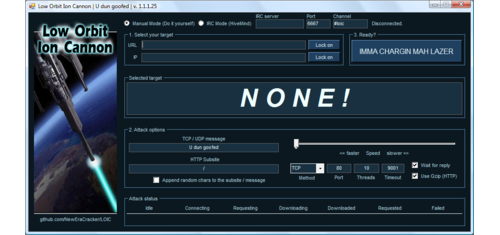
More commonly known in the hacker community as a Low Orbit Ion Cannon (LOIC or WebLOIC), an Internet cannon is a type of computer program used to force traffic overloads (or denial-of-service) onto targeted websites. It uses the Internet to blast out cyberattacks. It’s not a literal cannon.
So even though you read “Internet cannon” and were probably imagining something like this:
(US Navy)
it actually looks more like this:
(Wikimedia Commons)
Why does China have one?
A new report and analysis claims that China is using what is being termed the “Great Cannon,” ostensibly a type of LOIC, to force an overflow of Web traffic and malicious code onto sites its government wishes to squash in the name of censorship. (If a website is overwhelmed by traffic, real or manufactured, no one will be able to visit it.) The new cybertool is being used in conjunction with its “Great Firewall,” which already blocks access to sites like Facebook and Twitter on Chinese networks.
Denial-of-service attacks on two GitHub project pages last month arenow being credited to China’s Great Cannon. The GitHub pages were hosting Chinese censorship circumvention projects run by the anonymous, presumably Chinese activist site GreatFire.org.
Jeesh. That sounds terrible. What kind of country would build such a heinous cyberweapon?
Well, the United States has a similar program.
According to the New York Times, information provided in the Edward Snowden leaks outlines U.S. government systems that can intercept and redirect Internet traffic to a site of their choosing.
Of course, we don’t know of any instances where the U.S. has used an Internet cannon-type attack in domestic censorship.
“The N.S.A. and its partners appear to use the programs for targeted surveillance, whereas China appears to use the Great Cannon for an aggressive form of censorship,” the Times piece explains.
Should the fact that China is using an Internet cannon scare me?
Essentially any site is and has been vulnerable to attacks of this nature (though greater encryption can help better protect against them). So no one should be any more afraid of it happening today than ever before. The only difference now is that, if the Chinese government is found to be attacking U.S.-hosted sites, we could have an international cyberdispute on our hands.
The iPhone 6 and 6 Plus vaulted Apple to the top spot in China.CNET
From CNET
Apple has stolen the No. 1 spot in smartphone sales in urban China from local rival Xiaomi, according to market researcher Kantar Worldpanel ComTech.
For the three months that ended in February,Apple's iPhone 6 was the top selling phone in urban China with a market share of 10.2 percent, up from 9.5 percent for the prior three months. The iPhone 6 Plus was the third best-selling phone just behind Xiaomi's Android-based RedMi Note in second place. With the two new iPhones as well as older models selling robustly in China, Apple jumped to the top spot with 27.6 percent market share overall, Kantar said Wednesday.
As the world's largest smartphone market with almost 520 million users, China is prime territory for Apple and other mobile phone vendors. Apple aggressively pursued deals with China's three major mobile carriers, including top carrier China Mobile, to bring the iPhone to the country. China-based smartphone rivals, such as Xiaomi, have typically held the upper hand by offering high-quality phones at low prices. So Apple's rise in China is a clear sign of the appeal of the iPhone 6 and 6 Plus.
"There has been a strong appetite for Apple's products in urban China seen since the launch of the iPhone 6 and 6 Plus, and this has continued into Chinese New Year," Kantar Worldpanel research chief Carolina Milanesi said in a statement. "China Mobile's subscribers accounted for 59 percent of the 27.6 percent volume share recorded by iOS in the latest period."
Apple also made some headway against Android in France, Germany, Italy, Spain and the UK. Over the three months ended in February, Apple's smartphone market share climbed by 2.9 points in those five countries, while Android's share fell by the same amount. Still, Google's Android OS by far remained the dominant platform with a 67.6 percent share compared with Apple's 20.9 percent.
"In Great Britain, as Samsung prepared the channel for the arrival of the new flagships Galaxy S6 and S6 Edge, sales of the Galaxy S5 grew slightly over the previous period and captured 8.7 percent of smartphone sales, keeping this model as the second best selling smartphone after the iPhone 6," according to Kantar Worldpanel ComTech Europe business unit director Dominic Sunnebo.
Consumers who chose the iPhone 6 cited such factors as the phone's reliability and durability and its attractive design. Those who opted for the Galaxy S5 pointed to its reliability and durability as well but also said it was a good deal based on the contract.
In the United States, Apple's smartphone share inched down to 38.8 percent for the three months that ended in February, compared with 39.3 percent during the same period last year. But the iPhone 6 was still the best selling iPhone across the US. Buyers of the 4.7-inch iPhone 6 mentioned screen size as the No. 1 factor, followed closely by 4G LTE support. Among those who went for the 5.5-inch iPhone 6 Plus, 70 percent cited screen size as the top reason.
We’ve heard of people comparing Apple to an evil empire. But comparing the company to Hitler? That’s going just a bit overboard.
But that’s exactly what the founder and CEO of Chinese Internet video site Leshi TV, Jia Yueting, is doing to promote his company’s new Android-powered smartphone. We’re guessing Google, which makes Android, isn’t going to like this.
Spotted by The Verge, the ad, which was posted to Yueting’s Weibo page includes a South Park-ish caricature of Hitler standing with his arm raised in a salute, while his other arm wears a red Nazi armband. But instead of a swastika, the band has an Apple logo. Opposite the dictator is a group of mostly smiling children.
The image is meant to show that Apple’s iOS is a closed ecosystem that stifles innovation.Or something like that.
For most readers in the West, the use of any kind of Nazi iconography in an advertisement is viewed as abhorrent and unacceptable. In many southeast Asian countries, however, Hitler and Nazi images have been coopted into the mainstream. Last December, a popular Korean pop group dressed in outfits that resembled Nazi uniforms. Chinese couples have posted wedding photos to the web in which they are wearing Nazi military uniforms. And in Thailand, students have worn Nazi-style clothing to school, while the government released a propaganda film that appeared pro-Nazi. (”Hitler is huge in Thailand,” the Daily Beast proclaimed.)
So while it’s difficult to imagine the CEO of a major company outright comparing Apple to Hitler, it’s worth pointing out that there is a large cultural difference between Asia and Western countries when it comes to sensitivity toward Nazism.
That still doesn’t excuse the use of such imagery — not by a long shot — but it helps give the Leshi TV ad a bit more context.
Yahoo said it is consolidating operations at many of its offices, including its Sunnyvale headquarters.Yahoo
Yahoo is closing its office in China, the company confirmed Wednesday, a move that is expected to eliminate up to 300 jobs.
Yahoo employees based in the Beijing office were informed of the closure on Wednesday, a spokeswoman said. Yahoo offered no local products in China, and the office -- Yahoo's only physical presence in mainland China -- served as a research and development center.
"We are constantly making changes to realign resources and to foster better collaboration and innovation across our business," Yahoo said in a statement. "We will be consolidating certain functions into fewer offices, including to our headquarters in Sunnyvale, Calif."
Yahoo did not say how many employees were affected by the office's closure, but a source described as familiar with the matter told Bloomberg that the office employed 200 to 300 people. Yahoo counted 12,500 employees worldwide at the end of 2014, meaning the closure affects about 2 percent of its global workforce.
The closure comes amid increasing pressure to reduce expenses from investors, including activist investor Starboard, which has strongly suggested that Yahoo CEO Marissa Mayer cut at least $500 million in expenses. The company has cut about 600 jobs in the past six months, mostly at operations in Canada and India.
Yahoo has had a sometimes rocky experience in China. In 2007, the company settled a lawsuit brought by two journalists that accused the web portal of supplying the Chinese government with information that led to 10-year prison sentences. Lawmakers and human rights activists criticized Yahoo, which denied responsibility, saying it was merely complying with Chinese law.
The closure comes about a month after the Chinese government announced new rules that would require foreign-based tech companies to hand over source code, submit to audits and build deliberate back doors into both hardware and software products. The new rules, due to go into effect this month, were criticized by the Obama administration as a "major barrier" to trade and an open market.
The move was reported earlier by the South China Morning Post.
China calls Apple's iPhone a national security threat
Dennis O'Reilly/CNET
Apple's iPhone is under fire in China where state-run media claim it's a national security threat.
Chinese broadcaster CCTV on Friday reported the iPhone's Frequent Locations feature poses a potential national security threat. A researcher interviewed by CCTV said, if accessed, data collected by the feature could reveal the entire country's economic status and "even state secrets," according to Reuters, which earlier reported on the state-run news outlet's comments.
The iPhone's Frequent Locations feature, which was introduced inApple's iOS 7 operating system, has been cited by privacy advocates as a potential issue. The feature allows Apple, by default, to track your iPhone's location and ultimately provide location-aware information. iPhone owners can turn Frequent Locations off in their device's privacy settings.
Still, Apple can't be happy to be mentioned in the CCTV report. Apple CEO Tim Cook has consistently said China is his company's second most important market. Apple's partnership with Chinese mobile carrier China Mobile announced at the end of last year means Apple's market share in the country could expand rapidly. Having state-run media dousing the flames on its growth is nothing if not concerning for Apple.It's possible, though not confirmed, that this CCTV report was retaliation for American officials on Thursday saying Chinese hackers broke into US computer networks that house the personal information of federal employees. China often responds to US accusations of cyberspying by taking aim at American tech companies. Apple, Cisco, Google, IBM, and Microsoft are just a few of the tech companies to get caught in the crossfire.
Chinese paramilitary police officers in Tiananmen Square, Beijing, China.Getty Images
An increasingly testy dispute between China and the United States over cyberespionage is about to drag out in Silicon Valley.
Last month, the Justice Department unsealed an indictment charging five officers of China's People's Liberation Army of trying to steal US commercial trade secrets. The assumption is that the five belong to the shadowy specialist group, Unit 61398, which was described in a 2013 report by Mandiant as a government-run Shanghai computer spy group.
China, which has never confirmed the group's existence and says that the government has never supported any hacker activities, this week issued a call "to punish severely the pawns" of the US government for monitoring China and stealing secrets.
That fits with a familiar narrative. Ever since former contractor Edward Snowden one year ago disclosed the existence of extensive spying programs conducted by the National Security Agency, Chinese official media have suggested that American tech companies were in cahoots with Washington. (Coincidentally, Microsoft's top lawyer on Wednesdayurged the US to change its surveillance procedures immediately.)"US companies including Apple, Microsoft, Google, Facebook, etc. are all coordinating with the PRISM program to monitor China," the People's Daily said on its official microblog. (PRISMwas a government program set up to monitor foreign communications that cross US servers but which also gave theNSA access to the central servers of major tech companies.)
China also warned that it would favor domestic technology suppliers over US companies.
"To resist the naked Internet hegemony, we will draw up international regulations, and strengthen technology safeguards, but we will also severely punish the pawns of the villain. The priority is strengthening penalties and punishments, and for anyone who steals our information, even though they are far away, we shall punish them!" the statement said.
If China makes good on that threat, it will cost US technology companies billions in dollars in lost contracts. But this increasingly fraught Sino-American relationship is likely not going to improve anytime soon, notes Shen Yi, who teaches in Fudan University's department of international politics in Shanghai. CNET spoke with Yi to get a perspective on how China views the latest ratcheting up in tensions and the potential fallout suffered by US tech companies.
Q: Given Edward Snowden's revelations about the extent of NSA spy operations around the world, what's been the reaction to the US decision to indict five PLA officers?Shen Yi: That US decision triggered quite a lot of feedback from China's side. The decision to indict five PLA officers is a surprise to China, especially considering the revelations of the PRISM project by Snowden. According to Beijing's understanding, the US needs to apologize first for the abuse of its capabilities and should find a proper solution on all these issues involving China and the US via diplomatic negotiations.
Obviously, many US technology companies do business in China. Is there likely to be a major impact on their ability to operate in China because of the latest dispute between Washington and Beijing?Shen Yi: Of course there will be an impact. For quite a long time, since the end of the 1970s, these companies enjoyed an overwhelming advantage in the mainland market. One of the most important reasons that Beijing trusted these companies was the belief that technology companies are politically free, meaning that the company is not the secret agent of a foreign government, and the import of the technology could be a benefit to China's own national interest.
Does China believe that US tech companies are colluding with US espionage efforts?Shen Yi: It's very difficult for China to say no after Snowden released the evidence.
The Chinese government says it plans to put in place new procedures to deal with what it says are potential security problems with Internet technology and services used by sectors "related to national security and the public interest." What might this mean in practice?Shen Yi: In 2010, the Chinese government decided to research Washington's new concept: supply chain security. The newly reported procedures are nothing but the Chinese version of supply chain security and national security review procedures. Lots of Chinese companies enjoyed the warm welcome of such kinds of procedures and (now) it's Beijing's turn. Generally speaking, Beijing would like to duplicate the procedures deployed by Washington and its friends in Europe.
Is there a relationship between the PLA and Chinese state companies?Shen Yi: According to the report on the existence of a global system for the interception of private and commercial communications (the Echelon interception system), US companies like Boeing could directly collect commercial intelligence on the Airbus via the national intelligence infrastructure (offered by) Echelon. In my personal view, China should copy such kinds of cooperation to ensure that our companies could be assured of fair play in such an environment.
The US argues that the PLA stole commercial information over the Internet in order to benefit Chinese firms. Is there persuasive evidence to back up that allegation? Is the government irritated because it views this as just another example of the US trying to hold back China?Shen Yi: The US Department of Justice provides no more evidence than that found inside the Mandiant report about one year ago. Until now, no companies have been mentioned that directly benefited from the so-called hacking operation. Such an indictment, very easily, would revive the Chinese government's memory of the Cox Report in 1998 which implies that the development of China heavily depended on the stealing of high tech from the US. From theft of high tech to manipulation of the RMB exchange rate and to theft via PLA hacking again, it seems that the US favors the development of different narratives to explain the vivid development of the economy of China, and has tried its best to hold back China.
What's been the main takeaway for the Chinese government from the Snowden disclosures about cybersecurity? Were they caught unaware at the scale of the intelligence gathering being conducted over the Internet?Shen Yi: At least before Snowden, no information officially came from Washington telling Beijing that we are spying on you via the Internet. If the video upload by Mandiant is true and they could record the screens of the so-called Chinese hacker when he was "invading" some US companies, it seems that it would be difficult for Beijing to realize the existence of US intelligence gathering via the Internet.
From a national security point of view, how does the Chinese military view the cybergathering of intelligence?Shen Yi: My opinion is that the cybergathering of intelligence is a new arena for great powers like the US and China. The US already has overwhelming advantages in cyberspace. It seems that Washington, just like (American political scientist) Kenneth Waltz has mentioned, doesn't want to produce any self-restraint of its power in cyberspace.
Given the course that both countries are now on, how likely is it that we'll see a cyber conflict erupt between China and the US within the next 10 years? What will it take to prevent that from taking place?Shen Yi: Cyber conflict is not easy to define, but it would be difficult to say it will be 100 percent impossible. I think if both sides are not able to improve their strategic confidence in the cyberspace, it would be very dangerous.
A search for the Dalai Lama on Bing's Chinese language search engine in the US.
(Credit: Screenshot by Dara Kerr/CNET)
Is Microsoft censoring searches of certain Chinese terms in the United States? One Web site is standing behind its original accusation.
Microsoft's Bing allegedly delivers different results for English-language searches than for those in Chinese, The Guardian said on Tuesday. Run searches on such politically sensitive topics as the Dalai Lama, Falun Gong, and Tiananmen Square on Bing's English-language site and its Chinese-language site, and the results vary, the report claimed. The Guardian said the discrepancies were first noted by Chinese monitoring site GreatFire.
We've conducted an investigation of the claims raised by Greatfire.org.
First, Bing does not apply China's legal requirements to searches conducted outside of China. Due to an error in our system, we triggered an incorrect results removal notification for some searches noted in the report but the results themselves are and were unaltered outside of China.
Second, with regard to the freeweibo.com homepage being absent from Bing search results, our investigation indicates that at some time in the past the page was marked as inappropriate due to low quality or adult. After review, we have determined the page is acceptable for inclusion in global search results.
Bing aims to provide a robust set of high-quality, relevant search results to our users. In doing so, Bing has extremely high standards that respect human rights, privacy and freedom of expression.
Microsoft is a signatory to the Global Network Initiative, which is an effort by a multi-stakeholder group of companies, civil society organizations (including human rights and press freedom groups), investors and academics to protect and advance freedom of expression and privacy on the Internet. As part of our commitment to GNI, Microsoft follows a strict set of internal procedures for how we respond to specific demands from governments requiring us to block access to content. We apply these principles carefully and thoughtfully to our Bing version for the People's Republic of China.
GreatFire also chided Microsoft for failing to address its allegations of censorship on the international version of Bing in China."Most results are partially censored and hard to detect if you don't read Chinese," GreatFire claimed." But we selected a term that is completely censored so that even a non-Chinese reader can easily confirm that the censorship exists." As purported evidence, GreatFire pointed to a search for the word "Freegate" in Chinese on Bing's Chinese-language site as one that triggers the message: "Due to legal obligations imposed by Chinese laws and regulations, we have removed the results for these search terms."
"For Microsoft, this is an enormous opportunity -- do the right thing and stand up to Chinese censorship now," GreatFire said. "It has damaged your credibility with customers and China's efforts to boost its image overseas."


 (US Navy)