A crowdfunding campaign for South Carolina police officer Michael Slager raised more than $1,300 before it was shut down by Indiegogo.Screenshot by CNET
Moments after Oklahoma reserve deputy Robert Bates was charged with manslaughter in the fatal shooting of a suspect, a $25,000 fund-raising campaign to pay for his legal bills kicked off on Indiegogo.
By the next day, as cable news channels played footage from police body cameras that captured, in visceral detail, the shooting of the black suspect by the white officer, the popular crowdfunding site suspended the campaign with little comment or warning.
The site has now officially removed the campaign, saying it "did not meet their standards." Not a single dollar was raised.
This wasn't an isolated incident. Just a week ago, Indiegogo removed another campaign to raise cash to pay the legal bills of a white officer charged with murder in the killing of a black man, after a witness' smartphone video of the shooting went viral. In that case, the campaign for now-former South Carolina police officer Michael Slager raised more than $1,300 of its projected $5,000 goal before it was taken down. GoFundMe, another crowdfunding site, removed a similar page supporting Slager.
A shift is happening. Crowdfunding sites are typically places where people seek public donations for projects ranging from paying medical bills to helping the homeless to starting up businesses to manufacturing a product. Some campaigns even invite donors to contribute in exchange for one of the finished products.
Now those same crowdfunding sites -- whose reputations were built on helping musicians, artists and other people behind good causes raise money -- are becoming new portals to fund people involved in controversial, emotionally charged issues.
It's not just to help policemen accused in shootings. A campaign for a small-town Indiana pizzeria that publicly supported a controversial "religious freedom" law critics said was anti-gay took in more than $800,000 in crowdfunding -- despite a national backlash. Similarly, a Washington state florist that was fined $1,000 for refusing to sell wedding flowers to a same-sex couple netted nearly $170,000 in crowdfunding.
It raises the question: Is every major polarizing issue now a cause worth crowdfunding?Also, before the coast-to-coast outcry over the fatal shooting of Michael Brown, who was black, by white Ferguson, Mo., police officer Darren Wilson last summer, fund-raising pages were set up for both men. Wilson's GoFundMe page even netted more than a quarter-million dollars before it was shut down without explanation.
"I think it was kind of inevitable that crowdfunding would be used to address more controversial, divisive issues," said Rodrigo Davies, a crowdfunding researcher at Stanford University. "I'm not at all surprised. It was just a matter of time."
However, Davies, who also is the head of product at the civic crowdfunding site Neighborhly, said what does surprise him is that Indiegogo and GoFundMe pulled the crowdfunding pages of the officers involved in the recent shootings, and that they did so without any rationale.
"They can't just hold their hands up and say, 'Hey, we're just a host,'" Davies said. "What they have done now sets the tone for future campaigns."
A GoFundMe spokeswoman declined to comment and an Indiegogo spokesman had no immediate comment.
Richard Swart, a researcher at the University of California, Berkeley who focuses on crowdfunding, has a similar point of view.
"I would've yanked them down, too," Swart said, but that doesn't mean the sites should have. "I think they were politically polarizing, and I don't think crowdfunding is meant to create polarization."
Swart said this hot-button type of crowdfunding has been happening in America for the past couple of years with no signs of letting up.
Both researchers say more politicized, niche crowdfunding sites will eventually sprout up.
"We're just scratching the surface for sure," Davies said. "Is there an issue you're passionate about, and can we apply collaborative funding to it? Probably."
The slender smartphone you’re carrying in your pocket has more computing power than NASA needed to put a man on the moon. If you’re looking for someone to thank for that technological miracle, you can start with Dr. Gordon Moore.
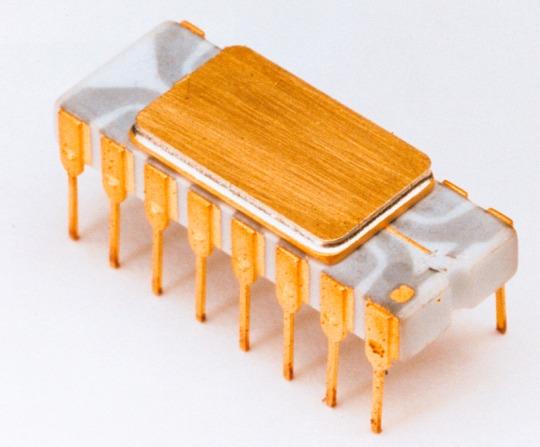
Intel’s original microprocessor, the 4004 (Intel).
This Sunday marks the 50th anniversary of “Moore’s Law,” a dictum that has guided the technological revolution from the earliest days of silicon through the iPhone 6.
On April 19, 1965, Gordon Moore, then director of research and development at Fairchild Semiconductor, published an article in an industry trade journal with the informal title “Cramming more components onto integrated circuits.”
In the Electronics article, Moore noted the exponential growth in the development of silicon and made a bold prediction: The density of electronic circuits would double every year, while the cost of producing them would drop at a similar rate. In 10 years, he surmised, we would see as many as 65,000 transistors crammed onto a single chip.
Here’s what Moore wrote in 1965:
“Integrated circuits will lead to such wonders as home computers – or at least terminals connected to a central computer – automatic controls for automobiles, and personal portable communications equipment. The electronic wristwatch needs only a display to be feasible today.”
Moore’s vision was more spot on than anyone could have imagined.
Moore is more
In the year Moore’s article appeared, Syvania manufactured the first read-only memory (ROM) chips. They held a whopping 256 bits of data (enough to hold 32 characters, or about ¼th of a tweet) and were programmed one bit at a time by a technician who carved the connections into the chip by hand.
Three years later, Moore and Robert Noyce left Fairchild to form a new company. Then called it Intel. In 1971, Intel released its first general-purpose microprocessor: the 4004. It was the size of a thumbnail and held a whopping 2,300 transistors. Today’s Intel Broadwell-U processor is roughly the same size yet holds nearly 2 billion transistors. The chip also costs 1/60,000th as much to produce.
To honor the 50th anniversary of Dr. Moore’s observation, Intel released a series of brain-melting comparisons to what would have happened to other industries if they had followed the same growth trajectory.
* If automobiles improved at the rate of Moore’s law, they would go nearly 300,000 miles per hour, get 2 million miles to the gallon, and cost only 4 cents. They’d also be the size of ants.
* A trip to the moon that required 3 days and $25 billion in 1969 would take you one minute and cost about the same as a private plane.
* If skyscrapers increased in height at the same rate, they would be 35 times taller than Mount Everest. They’d also cost less than the price of your average PC.
* Had housing prices plummeted at the same rate as the cost of producing chips, you’d be able to buy a home for the price of a piece of candy.
Long arm of the law
It wasn’t until 1975 when Caltech professor Carver Mead dubbed the prediction “Moore’s Law.” But as Moore notes in a recent video interview, his “law” was really more of a guideline – an aspiration for others to follow or plan around.
“The message I was trying to get across was that integrated circuits were the road to less expensive electronics,” Moore said.“It really evolved from being a measure of what goes on in the industry to something that more or less drives the industry.”
Moore himself later revised his prediction to say that circuit density would double in two years instead of one. No matter – the world was transformed anyway.
And the best may be yet to come.
“The potential is there for this change to continue, and I’m continually amazed at where it seems to be going,” Moore adds. “Just remember, whatever has been done can be outdone.”
Apple is offering free workshops to help educate Apple Watch owners.Screenshot by Lance Whitney/CNET
New owners of the Apple Watch can enroll in free workshops at Apple Stores to learn how to use the wearable device.
As of Thursday, the websites for some Apple Stores have been displaying an Apple Watch Basics class among their list of free workshops, as spotted Thursday by blog site MacRumors. The description for the class asks you to bring your Apple Watch and iPhone to learn how to get started with "glances" gestures, watch faces and more.
"Glances" display small slides of information that you access by swiping up the face of the watch. Gestures allow you to navigate the watch's interface by swiping or tapping. And Apple offers a variety of faces for its smartwatch, many of which are customizable.
Some stores are also showing a second class called Stay in Touch with Apple Watch, which is geared more toward using the device for communications. This workshop will show how to respond to messages and mail, share location, take a call and send a heartbeat to someone you care about. The Heartbeat feature lets you send your actual heartbeat to someone using the watch's built-in heart rate sensor.
Apple offers free workshops on other topics and products, including the iPhone, iPad, iCloud and the Mac. But the Apple Watch will demand some special training since it's an entirely new product category and packs a lot of features into a small package. Apple is offering short, hands-on demos of the watch available by reservation for consumers who want to check one out before a potential purchase. But people who end up buying the watch would likely benefit from more in-depth workshops.
The two workshops start April 24, which is when the Apple Watch goes on sale. But if your local Apple store is offering the workshops, you can reserve a spot now. I had trouble finding workshops at Apple Stores in the US. Only two stores that I stumbled upon displayed the Apple Watch Basics class; one of them also showed the Stay in Touch with Apple Watch class. But undoubtedly, more stores will start to list them as April 24 nears.
The workshops themselves take place every 90 minutes throughout the day and also are available on weekends. With heavy demand already popping up for the Apple Watch -- analyst estimates for preorders have ranged from 1 million to 2.3 million -- the workshops are likely to be a hot commodity. The problem is figuring out when to book the workshops, especially since you'll need your Apple Watch to attend.
Various Apple Watch models are now showing ship dates anywhere from four weeks to sometime in June. Either way, anyone who preorders an Apple Watch now certainly won't have one by April 24. In addition, it's possible that the device won't be available for in-store purchase until June. Up to then, all sales will be online.
The best bet for buyers may be to wait until you actually get the watch or receive a confirmed delivery date and then book a workshop. Of course, you can always schedule a workshop in anticipation of getting the watch on a certain date and then cancel or reschedule should it fail to arrive in time.
Samsung isn't just the world's biggest smartphone maker but is also one of the largest semiconductor vendors on the planet. Its operations are based in South Korea, as pictured here in 2013.Shara Tibken/CNET
Samsung, the world's biggest maker of smartphones and TVs, is also dead serious about chips.
Samsung is proof that Moore's Law matters, the idea that processor power improves exponentially every two years. But to keep up the pace of chip innovation, the industry has had to throw a lot of money and a lot of great minds at the problem. So far, it's paid off for Samsung. The company is the world's biggest vendor of memory chips and the second biggest processor maker overall after Intel, which was co-founded by Gordon Moore, the man behind Moore's Law. Chances are you have a Samsung product in your life, even if it's the flash memory in your favorite tablet.
CNET
Today's chip-making business is a race to the tiny. The first companies to make next-generation products smaller and faster stand to win more customers -- at their rivals' expense -- and to recoup their investments. The also-rans? Not so much.
"It's very important for us to be first," said Kelvin Low, senior director of foundry marketing for Samsung's semiconductor business. "These days, second and third becomes extremely challenging ... because from that point on, securing market share is difficult."
Being first is so important, in fact, that Samsung skipped a step in the manufacturing process to get to more advanced chip technology before most of its rivals. Instead of having to learn one new technique, it's implementing at least three at once. That, though, can lead to problems like poor yields.
So far, the risk is paying off. Samsung is attracting new customers, which will give it a bigger slice of the foundry market -- manufacturers hired to build chips designed by so-called "fabless companies" like Qualcomm and Nvidia. Analysts believe Samsung's chip manufacturing business has won back Apple as a customer for the next iPhone processor, giving it both revenue and prestige. Apple buys more chips than any other company on the planet except Samsung, but the Korean company lost Apple's business last year because of ongoing legal fights over phone and tablet designs.
One misstep or delay, though, and all of Samsung's newly won customers might defect to other processor manufacturers.
Keeping up with Moore
In 1965, Intel's Moore noted that chips would double in complexity at a rapid, regular rate -- initially he thought every year, but later revised that to every two years -- as the building blocks of the processor got smaller and were more tightly packed together. That made devices faster, cheaper and more power efficient. His observation, dubbed Moore's Law, has been true for the past 50 years.
But it's become massively expensive for chipmakers to keep up.
It's now largely up to four manufacturers to keep Moore's Law going -- Intel, Samsung, Taiwan Semiconductor Manufacturing Co. (TSMC) and Globalfoundries. If those companies don't keep advancing, the smartphones we use will stop getting smarter, and the battery life of those devices will never stretch past a day or two.Moving to each new generation of processor technology takes years of development and billions of dollars in research, equipment and construction costs. Building a new semiconductor factory can cost upwards of $10 billion, limiting the companies willing and able to play at the leading edge of chip technology. It's also become exponentially more expensive for fabless chip companies to design advanced processors, which means those that don't need the most-advanced technologies for things like high-end smartphones and data centers will be slower to adopt the newer chips.
Innovation could simply stall.
Chip manufacturing is a big business. Last year, foundries made $46.85 billion in sales, up 16 percent from 2013, according to Gartner. TSMC led the group with more than half of all market share. Samsung, by comparison, ranked No. 4 with 5.1 percent share (though the figure didn't take into account the chips the company builds for itself for use in its smartphones and tablets).
Samsung is in a unique position in the chip market. It not only designs and manufactures semiconductors for its own electronics but also builds processors for other companies -- most notably, smartphone rival Apple. TSMC solely manufactures processors designed by others. Globalfoundries licenses Samsung's technology to build advanced processors for other companies. While Intel has dabbled in the foundry market -- building chips for a few small companies it doesn't compete against -- it dedicates the bulk of its manufacturing capacity for its own processors.
Second place = first loser
Being first with new technology doesn't just bring bragging rights. It attracts more customers and fills a manufacturer's factories -- helping it make more money that it can then invest in even more factories. If a chip manufacturer doesn't have a factory running at capacity, it doesn't make back the money it invested to build the facility in the first place.
Samsung surprised the industry when it started producing what's currently the most advanced technology -- known as 14 nanometers, or billionths of a meter, in reference to the size of part of a transistor -- ahead of TSMC by several months. TSMC said it plans to move to the newer technology later this year, but being even six months behind has put it at a disadvantage when it comes to attracting customers.
TSMC didn't respond to a request for comment, but the company on Thursday projected lower revenue in its current quarter in part because of tougher competition in the chip market.
Samsung is the world's biggest memory chip maker, which most of its processors built in South Korea factories, pictured here in 2013.Shara Tibken/CNET
"In the last two decades ... the most bleeding-edge technology [aside from Intel] was all developed by TSMC and its foundry service," said Gartner analyst Samuel Tuan Wang. "Now Samsung, for the first time in history, is beating the schedule of TSMC in process technology by almost two quarters."
Samsung also hit that milestone about six months after Intel -- instead of lagging its US rival by years. But Intel, while currently selling many 14-nanometer PC chips, has been slower to apply the technology to its mobile processors. Since more smartphone chips are sold than PC chips, Intel has been missing out on the faster-growing market. Samsung's Galaxy S6, which will likely be the Korean company's top-selling smartphone this year, is the first product to use Samsung's 14-nanometer chips.
How did Samsung beat TSMC? It decided to skip over 20 nanometers, the technology that's currently used by TSMC to build Apple's A8 and A8X iPhone chips and iPad processors. Instead, Samsung turned its attention and R&D investment to 14 nanometers.
"It was not an overnight thing ... [and] it's not magic," Low said. "We basically put more focus on 14 nanometers, while some other foundries chose to put [their] focus on 20 or 22."
Even if Samsung has the best technology among the foundries (not including Intel), there are risks to relying on the company as a chip manufacturer. Samsung often talks about a sort of Chinese wall between its electronics business and its chip operations, which means that the chip side of Samsung keeps confidential the products that other consumer electronics makers are building that require its processors. But it can be tricky working with a fierce rival, and it's hard to imagine Samsung spurning business from its biggest customer (itself) to meet demand for its other customers first.
For now, the question is whether Samsung can cement its momentary lead over TSMC and even catch up to Intel. Intel, for one, won't be ceding its longstanding manufacturing leadership without a fight, saying it doesn't believe any rivals will pass it when it comes to advanced chip technologies.
"I don't think that's likely, time-wise or feature-wise," Mark Bohr, an Intel senior researcher who heads a team developing the company's future chips, said when asked how likely it is that Samsung and TSMC will catch up.
Samsung in front
Still, Samsung is signing up new customers, both for its older 28-nanometer technology and its new 14 nanometers. Nvidia, one of the world's biggest graphics chipmakers, revealed in a regulatory filing last month that it added Samsung as a manufacturing partner. A year earlier, it relied mostly on TSMC.
Nvidia declined to provide information about which of its chips will be built by Samsung but said in a statement that TSMC "is and will remain a very important foundry partner for us."
Qualcomm, the world's biggest provider of the 3G and 4G LTE chips used to provide wireless service in mobile devices, also is expected to turn to Samsung for its upcoming Snapdragon mobile processors.
A museum in Samsung's chip manufacturing factory in South Korea (pictured in 2013) shows the company's progress in semiconductors since the 1970s.Shara Tibken/CNET
Qualcomm declined to comment.
And then there's Apple.
Samsung's foundry business took a hit last year when Apple turned to TSMC. The two companies had worked together for years to build chips for iPhones and iPads, but that was before Apple and Samsung faced off in high-profile patent-infringement suits.
The loss of Apple's chip business was a blow to Samsung's reputation and financial results. Gartner estimates Samsung generated $2.7 billion in sales from building Apple's chips last year, down from $4.3 billion in 2013 when it was Apple's primary manufacturer.
Market watchers believe, however, that Apple will return to Samsung for the production of at least some of the 14-nanometer A9 chips it's expected to use in the next iPhone, which is rumored for release later this year.
"Samsung is likely to take substantial share of [the] Apple A9 foundry business," Jefferies analysts noted last month.
Apple declined to comment. Samsung also declined to talk about customers beyond saying its customer list "is growing."
TSMC won't be going away either. Its foundry business is 10 times the size of Samsung's, and it doesn't have any of the tricky "frenemy" issues chip designers find with Samsung.
Other companies uncomfortable with partnering with a rival can work with Globalfoundries instead. Now owned by the investment arm of the government of Abu Dhabi, Globalfoundries works closely with Samsung and licenses the Korean company's technology for 14 nanometers. Analysts believe Apple, Qualcomm and others will rely on Globalfoundries as a second source for Samsung's manufacturing techniques, which also helps mitigate competitive risks and supply shortages.
The race continues
While Samsung's chip fortunes may be on the upswing, that could all change tomorrow. In the new manufacturing race, no one can risk slowing down.
Some experts predict that Intel, TSMC and Samsung will be neck-and-neck in delivering the next generation of technology, 10 nanometers. If Samsung and TSMC catch up with Intel, said Dan Hutcheson, CEO of chip-manufacturing research firm VLSI Research, it would weaken Intel's edge and make it even harder for the Santa Clara, Calif., company to break into mobile. And if TSMC beats Samsung to the technology, it could regain all the customers it has lost.
It's like a giant hamster wheel, with billions of dollars at stake.
"If you want to win the market, you cannot stop," Gartner's Wang said. "Once you stop, you fall behind, and that's the end of the game."
Former Yahoo CEO Carol Bartz and former Microsoft CEO Steve Ballmer sign their search pact in 2009.Yahoo/Microsoft
The odd couple of search -- Microsoft and Yahoo -- have tweaked their partnership to give Yahoo more wiggle room.
The amended agreement, signed by Microsoft CEO Satya Nadella and Yahoo CEO Marissa Mayer, has two main elements. First up, Yahoo will now be allowed to have more "flexibility to enhance the search experience" across mobile and desktop devices. In addition, the companies have modified their handling of ad sales, with Microsoft now exclusively handling the Bing ads on Yahoo Search and Yahoo continuing to sell ads through its own Gemini ads platform.
"We firmly believe that search is still in its infancy - and this partnership marks the next chapter in our exploration of how to make search truly great," Mayer said in a statement Thursday.
The updated to the search deal comes six years into a 10-year pact between the companies. In 2009, two former CEOs -- Microsoft's Steve Ballmer and Yahoo's Carol Bartz -- signed a deal that would see Microsoft's Bing platform power Yahoo search. In return, Yahoo would be the exclusive sales force for ads and would receive a significant sum each year to be the brains behind Yahoo search.
At the time, both companies said that the deal represented a "significant opportunity" and some analysts suggested it was an attempt on Microsoft's part to get closer to Google on search usage and drive more revenue through online advertising.
The new deal between the companies comes at a crucial time for both firms. Mayer, who came to Yahoo from search giant Google, is in the process of transforming the company into one that's friendlier to mobile devices and more capable of generating revenue off those products. Mayer is also keenly aware of Yahoo's slumping position in the online world, which has driven her to make dozens of major acquisitions over the years.
Nadella, meanwhile, has refocused Microsoft on services and mobile, and becoming platform-agnostic with its many platforms, including Office. Under Nadella's leadership, Microsoft has attempted to make clear that it no longer views itself as a software company, but rather a cloud services and mobile firm that provides software.
That was made abundantly clear earlier this year when Microsoft announced that it would offerWindows 10, its upcoming operating system, for free. Microsoft has historically sold new Windows versions for hundreds of dollars to drive revenue and profits. Nadella sees his company's future in other areas.
Details on the new Yahoo-Microsoft agreement are being kept close to the vest. In a statement on her company's blog on Thursday, Mayer would only say that the deal "opens up significant opportunities in our partnership, enabling both partners to improve the search experience, create value for advertisers, and establish ongoing stability for partners."
That said, Yahoo did note that the original structure of the companies' deal, including how Microsoft would handle search and the revenue-sharing agreement between the companies -- "remains unchanged with today's updates."
Neither Microsoft nor Yahoo immediately responded to a request for comment.