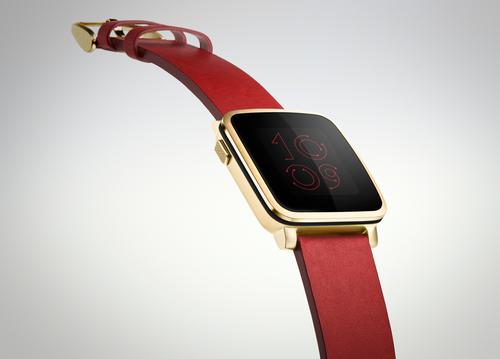
A week after the ridiculously successful Kickstarter debut of the new Pebble Time, smartwatch maker Pebble is back with an even newerwatch, the Pebble Time Steel.
The Pebble Time Steel also comes with both a leather band and stainless steel band. Based on what I’ve seen out of smartwatches so far from any company„ the Time Steel is easily one of the most attractive watches around.
(I would be remiss, however, if I didn’t mention that the Time Steel, with its square face and rounded edges, looks a bit like Apple’s upcoming Apple Watch.)
Beyond its fashion-forward design, the Time Steel also gets up to 10 days of battery life, three more than the standard Pebble Time. (And likely nine days more than the Apple Watch, if reports are correct.)
Looks and battery life aside, the Pebble Time Steel is the exact same smartwatch as the original Pebble Time. Both come with color e-paper displays and curved bodies that contour to your wrist.
Both watches also come with Pebble’s new timeline interface, which lets you scroll through past, present, and future events. So you can check out your old emails and scores from last night’s games, then check the current time, and finally move on to your upcoming events.
The watches also include a new microphone for voice dictation, so you can take quick notes or reply to messages from your friends.
Unlike most smartwatches on the market, the Time and Time Steel work with both Android and iOS devices. Google’s Android Wear watches don’t support Apple’s iPhone, while Apple’s upcoming Apple Watch won’t support Android phones.
The Time and Time Steel will also offer support for optional smart straps that will allow developers to add additional functionality to the watches. As it stands, neither the Time nor Time Steel include GPS tracking or heart rate monitors.
A developer could, however, develop a smart strap with a built-in GPS and heart rate monitor that, when connected to the Time or Time Steel, would instantly give the watches those capabilities. Think of it as a modular design for a smartwatch.
According to Pebble, the Time Steel will cost $299 when it goes on sale, $100 more than the Pebble Time. Early Kickstarter backers, though, can get the watch for $250.
And if you’ve already put your money toward the Pebble Time, Pebble says you can easily upgrade to the Time Steel without losing your place in line.
As it stands the Pebble is the best smartwatch maker around. But Apple is set to host an event for its upcoming Apple Watch on March 9th.
Will Pebble be able to stay on top? The clock is ticking.
It's got a color screen. It has a microphone. But it's also low-key. I stared at Pebble's latest watch, the Pebble Time, and thought: this is almost cutesy.
The newest Pebble watch, unveiled today, isn't a kick-out-the-stops smartwatch like those that run Google's Android Wear software, or Apple Watch. In many of ways, it's a throwback to the original Pebble: a simple, plastic-looking, almost toy-like design. When CEO Eric Migicovsky demonstrated a white model on his wrist, it resembled a Casio watch crossed with a Tamagotchi.
Pebble Time isn't a huge leap forward from previous Pebbles. It's backwards-compatible with the 6,500 Pebble apps and watchfaces already out there. The difference is mostly about the software...and a few hardware tweaks. But is this enough to draw in new buyers in an increasingly-crowded smartwatch market?
Like the other Pebbles, the Pebble Time aims for a seven-day battery life, is swim- and shower-friendly, and has physical buttons. But the Time has a color e-paper display that has a faster refresh rate thanQualcomm's Mirasol screens, capable of 30 frames per second animation (I watched some Nyan Cat to prove it). It's meant to look good in everyday light, but it also has a backlight.
The 20 percent thinner body (down to 9.5mm) still looks chunky in photos, but it has a slightly curved body and a stainless-steel bezel, plus a Gorilla Glass-covered display, with touches of the higher-endPebble Steel. But the look definitely feels more cozy and, well, toy-like. It's rather clunky compared to high-design Android Wear watches like the LG G Watch R or Moto 360. Part of the issue, visually, might have to do with that stainless-steel bezel: it makes the bezel seem thicker, at first glance, than previous Pebbles, and thicker than recent Android Wear watches, even if it's more polished than the original Pebble.
The Pebble Time will come in three colors at first: red, white and black. The watch-strap is a standard 22mm, so it can be swapped, but a new pin makes it easier to switch them out.
A microphone allows voice-to-text translation, which will allow for quick responses to messages, much like Android Wear. On Android phones, this feature will work off the same API as Android Wear. On iOS, it'll be a trickier gambit: it's "more of chore," Migicovsky admits, and for now iOS voice-to-text will be limited to Gmail, where it'll work for responses in Mail or the Gmail app. The microphone will also store voice memos, and allow you to potentially shoot actual voice responses to people to play back on their phones (the Pebble Time itself lacks a speaker).
From left to right: the original Pebble smartwatch, the Steel and the Time.James Martin/CNET
Expansion: A hardware port, you say?
The Pebble Time has another new feature: a hardware port.
The Pebble Time, like the existing Pebble, won't do a ton of fitness tracking by itself. Instead, a charge connector will double as a serial port for future hardware peripherals. Why? "Why not?" asks Migicovsky. His take is that Pebble isn't an expert on sensors, so future sensor innovators could develop accessories that snap into the Pebble Time and use it to run their hardware.
It may be wishful thinking, but the cool part is that it sounds like Pebble Time is very hackable by design. The Pebble Time will also be capable of connecting with Bluetooth LE fitness accessories, such as heart-rate monitors.
Time-based OS
Pebble Time runs a revamped type of OS, using a "new metaphor," according to Migicovsky: time itself. Instead of scrolling apps, the new Pebble OS runs off a timeline. The top button scrolls back in time, the bottom forward. Notifications, appointments and Google Now-like info pings get pinned along the timeline, and you click on one to open up more information, almost like a mini-app. The Weather Channel and ESPN are on board to serve notifications to the Pebble Time's new OS, with more services to come.
Sound a bit like Android Wear? It did to me. Pebble's new OS is meant to skip apps, but the apps are still there: pressing a center button brings up the apps in at-a-glance thumbnails, which you can scroll through or open. The new Pebble Time has no maximum app limit, but there's no hint of how much storage the device has. Migicovsky admits that you'll probably only realistically keep up to 60 on it at a time. As for watchfaces, unlike the current Pebble, you'll only install one at a time. This time around the Pebble wants you looking at info, not clock designs.
Pebble's new OS organizes information by a user's past, present and future.James Martin/CNET
Hands-on impressions
CNET editor Lynn La checked out the Pebble Time in person, and admitted that while it did look rather chunky, the Time is downright slim compared to the first generation. With its metal frame and sleeker aesthetic, the new design is appealing, and reflects a more finished and elegant end-product for Pebble.
The e-paper display is indeed easily viewable outdoors, and though the colors and resolution purposefully don't compare to high-end smartwatches, the Time is still comfortable to read and navigate. The charming simplicity of the Pebble 3.0 OS is also user-friendly, and by organizing its UI around your personal schedule and interests, it feels more intuitive than continuously switching out to different apps.
Price and availability: Soon
The Pebble Time is available now to pre-order on Kickstarter, a move designed to appeal to early Pebble adopters. For $159, you can get one by May. The Pebble Time will retail later on for $179 and then $199, which is the same price as the Pebble Steel. (UK and Australian prices have yet to be announced, but $179 converts to roughly £115 or AU$230; the Steel currently sells for £179 in the UK, which is AU$355.)
The original Pebble and Pebble Steel will still be sold: in fact, the good news is that those older models will get the newer timeline-based OS later this year, after the Pebble Time debuts.
Smartwatches galore will fill up 2015. Will Pebble Time find its way amid all this new wrist-gear? The price isn't far off most Android Wear watches. It may not stand out as much as the original Pebble, but it looks like the goal this time around is to turn what works about the existing watch into something more appealing for everyone else...and avoid diving into the high-tech sensor game for now.
A few years ago, people, especially tech observers, were writing off watches. Fewer people were wearing them to tell time, relying instead on their smartphones. Now, the wheel turns full circle. Watches are back in fashion. And the very names that made smartphones cool - as well as a number of others - are getting into the smartwatch business.
Take the Pebble smartwatch Kickstarter campaign. In 2012, a group of engineers launched a campaign for a smartwatch. It would connect to your phone and alert you about incoming calls, text messages, emails, tweets - all the stuff that appears on the homescreen of your phone. The watch also promised an SDK, allowing third-party developers to create their own apps for the watch.
The Pebble campaign met its $100,000 target in a matter of hours. By the time the campaign closed, it had raised more than $10 million, making it the most successful Kickstarter campaign ever. Clearly, there was a market for smartwatches , and both phone and watch manufacturers noticed.
The tech sites and blogs are abuzz with the news of the Apple smartwatch, but at this point, the watch is still vapourware. But Samsung's Galaxy Gear watch is scheduled for release tomorrow.
Toshiba released a prototype that would link to your phone as well as measure your heart rate. The Kreyos smartwatch allows for handsfree connection, powered by gestures and voice control, and it links to your phone. E4Worlds I3 watch has a touchscreen and a camera.
The hand turns and the watch is cool again.
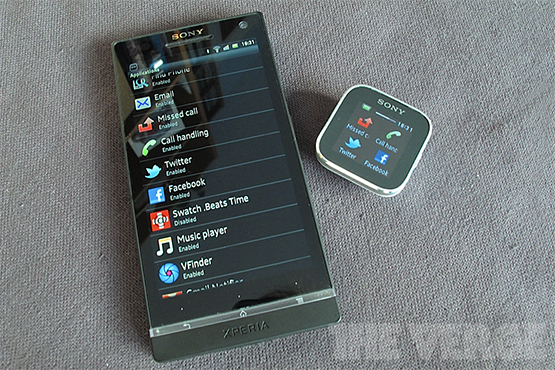
Dive into 40 apps The Sony smartwatch has a 1.3-inch OLED display. Its power button is in the place you would find the winding knob. The display resolution is 128x128, and it is capable of showing 65,536 colours. It is touch based, supporting 2-finger multi-touch . It uses Bluetooth to connect to the phone. There are 40 apps available, including Facebook, Twitter, text messaging and music. The watch has two view modes: full screen and widget. Sony says that the watch can handle 3 to 4 days of use before recharging.
Get text, email alerts The Casio product is more limited than the Sony and Samsung offerings. The latest model, GB-6900 B, can connect to the iPhone 4S and iPhone 5.
It uses Bluetooth 4, vibrates and displays call, text and email alerts. It can control smartphone music players, and has a battery life of 2 years. The Find-Me phone feature allows users to send a signal that makes a phone ring and buzz for 15 seconds, overriding phone settings.